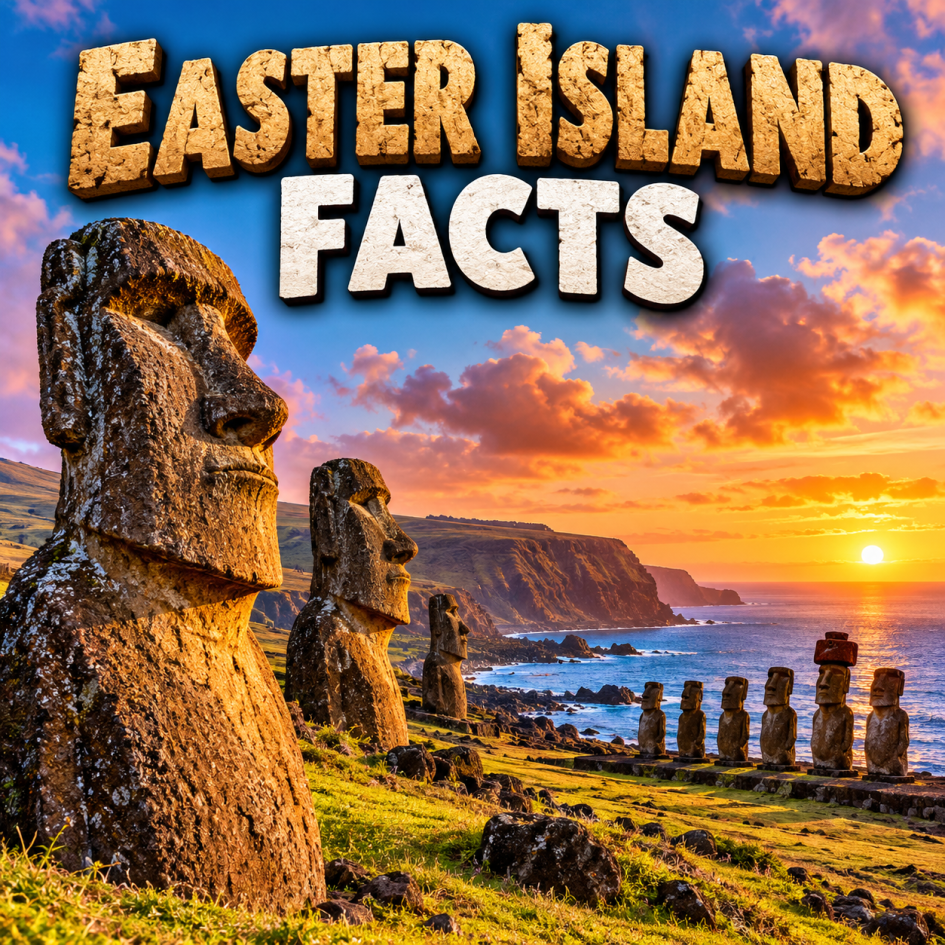
Easter Island, also known as Rapa Nui, is one of the most mysterious and fascinating places on Earth. Famous for its enormous stone statues, remote location and unique Polynesian culture, this small island in the Pacific Ocean has captivated historians, archaeologists and travellers for centuries. Here are 20 fascinating facts about Easter Island, its people and its remarkable history.
1. It has two names. The island is called Easter Island in English and Rapa Nui by its Indigenous people. Rapa Nui also refers to the island’s Polynesian culture and language.
2. It was named by a European explorer. Dutch explorer Jacob Roggeveen arrived on Easter Sunday, 5 April 1722. He named it Easter Island after the Christian holiday.
3. It is incredibly remote. Easter Island lies in the southeastern Pacific Ocean, approximately 3,700 kilometres from mainland Chile. Its isolation helped shape its distinctive culture.
4. It belongs to Chile. The island was annexed by Chile in 1888. Although geographically far from the South American mainland, it is politically part of that country.
5. It is famous for the moai statues. The island contains hundreds of enormous stone figures called moai. They were created by the Rapa Nui people to honour important ancestors and leaders.
6. There are nearly 1,000 moai. Archaeologists have documented around 900 to 1,000 statues. They vary in size, shape and stage of completion.
7. Some statues are enormous. Many moai stand several metres tall. The largest completed examples are approximately 10 metres high, although sizes vary considerably.
8. The statues have distinctive heads. Moai are famous for their large heads, prominent noses and long ears. However, many statues also have torsos, and some are buried partly underground.
9. They were carved from volcanic rock. Most moai were carved from compressed volcanic ash, called tuff, quarried at Rano Raraku. This material was easier to shape than many harder rocks.
10. One quarry contains unfinished statues. Rano Raraku is a volcanic crater where many moai were carved. Dozens of unfinished figures remain there, offering clues about how the statues were produced.
11. The statues may have “walked.” According to Rapa Nui oral traditions, the moai moved into position by themselves. Experiments suggest people could have transported some statues upright using ropes, rocking them from side to side.
12. Many face inland. Most moai on coastal platforms face towards the island’s interior, where communities lived. They are believed to have symbolically watched over and protected their people.
13. Some wore stone hats. Certain statues have red stone cylinders called pukao on their heads. These may represent topknots of hair rather than hats.
14. The island has three main volcanoes. Terevaka, Poike and Rano Kau helped shape its triangular landscape. Although the island is volcanic, its volcanoes are no longer active.
15. It has a UNESCO World Heritage Site. Rapa Nui National Park was added to the UNESCO World Heritage List in 1995, recognising its extraordinary archaeological and cultural importance.
16. It has a mysterious writing system. Rongorongo consists of symbols carved onto wooden objects. Researchers have not yet deciphered it conclusively, making it one of the island’s enduring mysteries.
17. A birdman competition once took place here. At Orongo, a ceremonial village beside the Rano Kau crater, a religious tradition centred on a competition to retrieve the first sooty tern egg from a nearby islet.
18. The island suffered a devastating population decline. During the nineteenth century, slave raids, introduced diseases and other outside pressures caused catastrophic losses among the Rapa Nui people.
19. Its culture survived. Despite centuries of hardship, the Rapa Nui people have preserved and revived their language, traditions, music, dance and cultural identity.
20. Its greatest mystery is still being explored. Archaeologists continue investigating how the statues were carved, moved and erected. Their research shows the ingenuity of the islanders who created this extraordinary cultural landscape.
Easter Island is much more than a place of giant statues. It is a living cultural homeland whose remarkable history demonstrates the creativity, resilience and achievements of the Rapa Nui people.
Leave a Reply