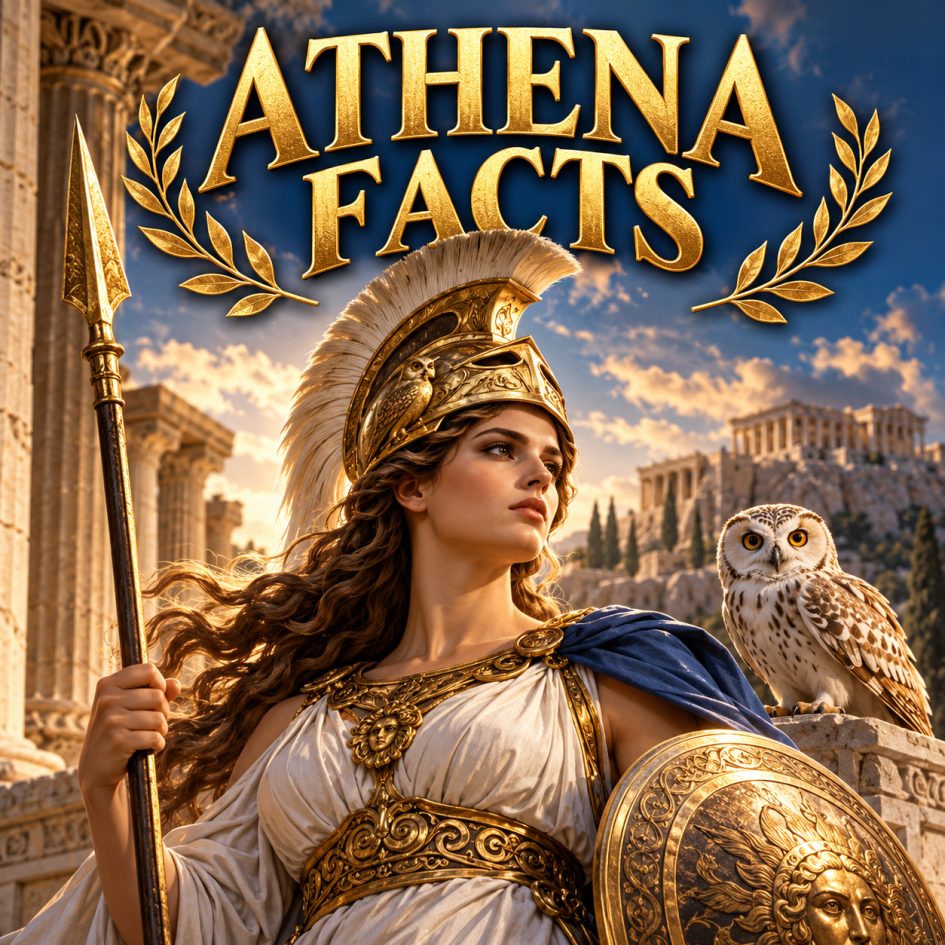
Athena is one of the most important goddesses in ancient Greek mythology. She was associated with wisdom, warfare, crafts, and strategic thinking. Here are 20 true facts about Athena, based on ancient Greek myths, literature, and archaeological evidence.
1. Athena was the goddess of wisdom.
Athena represented intelligence, knowledge, and good judgment. Unlike gods associated with strength alone, she often used careful planning to overcome challenges.
2. She was the goddess of strategic warfare.
Athena guided warriors through tactics and planning. She was different from Ares, the Greek god associated with the violence and bloodshed of battle.
3. Athena was the daughter of Zeus.
Her father was Zeus, king of the Greek gods. In the best-known version of her birth, her mother was Metis, a goddess associated with wisdom.
4. She was said to have been born from Zeus’s head.
According to Greek mythology, Zeus swallowed Metis while she was pregnant. Athena later emerged from Zeus’s head, fully grown and wearing armour.
5. Athena was one of the twelve Olympian gods.
She belonged to the group of major deities traditionally associated with Mount Olympus, the home of the Greek gods.
6. Her sacred symbol was the owl.
The owl represented wisdom and became closely associated with Athena. Owls also appeared on ancient Athenian coins.
7. The olive tree was sacred to her.
In a famous myth, Athena gave the olive tree to the people of Athens. The tree provided food, oil, and wood, making it a valuable gift.
8. Athens was named after Athena.
According to legend, Athena competed with Poseidon to become the city’s patron deity. The Athenians chose her gift of the olive tree over Poseidon’s gift, often described as a saltwater spring or a horse.
9. The Parthenon was dedicated to Athena.
This famous temple stands on the Acropolis in Athens, Greece. It was built in the fifth century BCE and honoured Athena in her role as the city’s protector.
10. Athena was often shown wearing a helmet.
Ancient Greek artists commonly depicted her wearing armour, carrying a spear, and holding a shield. These features emphasised her protective and military roles.
11. She carried a famous shield called the Aegis.
In Greek mythology, Athena was associated with the Aegis, a protective object often depicted with the terrifying face of Medusa. It symbolised protection and power.
12. Athena helped the hero Perseus.
In the myth of Perseus, Athena assisted him in defeating Medusa. She helped him approach the Gorgon safely by using a reflective shield.
13. She helped Odysseus return home.
In Homer’s Odyssey, Athena supports Odysseus throughout his difficult journey home to Ithaca after the Trojan War.
14. Athena played a major role in the Trojan War.
She supported the Greeks in the conflict against Troy. Her involvement appears in ancient Greek stories, including Homer’s Iliad.
15. She was associated with weaving.
Athena protected craftspeople, especially weavers. In the myth of Arachne, a talented mortal challenges Athena to a weaving contest and suffers the consequences.
16. Athena was known as a virgin goddess.
She was traditionally called Athena Parthenos, meaning “Athena the Virgin.” The Parthenon’s name derives from this title.
17. Her Roman equivalent was Minerva.
When Roman religion adopted and adapted Greek traditions, Athena became closely identified with Minerva, a Roman goddess of wisdom and crafts.
18. Athena was associated with heroes.
She frequently helped figures such as Heracles, Perseus, and Odysseus. Her assistance often involved clever advice, protection, or practical skills.
19. A giant statue of Athena once stood in the Parthenon.
The sculptor Phidias created a monumental statue of Athena, known as Athena Parthenos, for the temple’s interior. It was made using gold and ivory, but the original statue no longer survives.
20. Athena remains an important cultural symbol.
Today, Athena appears in books, paintings, films, games, and modern interpretations of Greek mythology. She continues to represent wisdom, courage, learning, and strategic thinking.
Conclusion
Athena was much more than a goddess of wisdom. Ancient Greeks associated her with military strategy, skilled craftsmanship, heroic adventures, and the protection of cities. Her connection to Athens, the owl, the olive tree, and the Parthenon made her one of the most recognisable figures in Greek mythology. Although the stories about her supernatural powers belong to mythology rather than verified history, the temples, statues, coins, and ancient writings connected with her provide real evidence of how deeply she influenced ancient Greek culture.
Leave a Reply