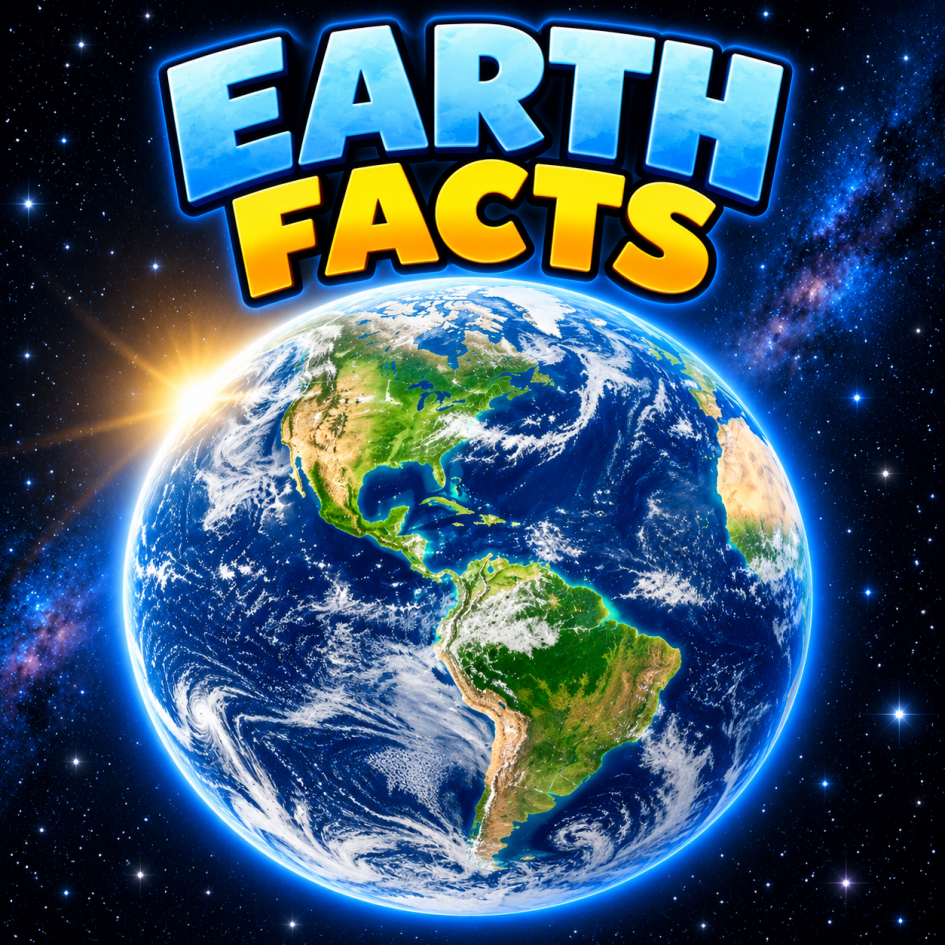
Earth is our home planet, full of incredible natural wonders, fascinating features, and mysteries. From its fiery interior to its vast oceans, there is so much to discover. Here are 20 amazing facts about Earth!
1. Earth Is About 4.5 Billion Years Old
Scientists estimate that Earth formed approximately 4.54 billion years ago. It developed from dust and gas surrounding the young Sun, gradually becoming the planet we know today.
2. Earth Is the Third Planet from the Sun
Our planet is the third planet in the Solar System, after Mercury and Venus. It lies at a distance that allows liquid water to exist on its surface.
3. Earth Is Mostly Covered by Water
Around 71% of Earth’s surface is covered by water, while about 29% consists of land. Most of this water is found in oceans, and only a small fraction is freshwater available in rivers and lakes.
4. Earth Is Not a Perfect Sphere
Earth is slightly flattened at its poles and wider around its equator. This shape is called an oblate spheroid, caused mainly by Earth’s rotation.
5. Earth Has One Natural Moon
Our Moon helps create ocean tides through its gravitational pull. It also helps stabilise Earth’s axial tilt, contributing to a relatively stable seasonal pattern over long periods.
6. Earth Rotates Every 24 Hours
Earth takes approximately 24 hours to complete one rotation. This movement causes day and night as different parts of the planet face towards or away from the Sun.
7. Earth Travels Around the Sun
Earth completes one orbit around the Sun in approximately 365.25 days. The extra quarter-day explains why we have a leap year almost every four years.
8. Earth Has Five Major Oceans
The five recognised oceans are the Pacific, Atlantic, Indian, Southern and Arctic Oceans. The Pacific is the largest and deepest of them all.
9. Earth Has a Protective Atmosphere
Our atmosphere contains gases such as nitrogen and oxygen. It helps regulate temperatures, provides the air we breathe and protects life from much of the Sun’s harmful radiation.
10. Earth Has a Powerful Magnetic Field
Earth’s magnetic field is generated largely by moving molten iron in its outer core. It helps shield the planet from charged particles carried by the solar wind.
11. Earth Has Continents That Move
Earth’s outer shell is divided into tectonic plates that move slowly over time. Their movements cause earthquakes, volcanic eruptions and the formation of mountains.
12. Mount Everest Is the Highest Mountain Above Sea Level
Mount Everest, in the Himalayas, stands approximately 8,849 metres above sea level. However, when measured from its underwater base, Hawaii’s Mauna Kea is taller.
13. The Deepest Ocean Point Is Extremely Deep
Challenger Deep, in the Mariana Trench in the western Pacific Ocean, reaches roughly 11 kilometres below sea level. The pressure there is immense.
14. Earth Experiences Different Seasons
Seasons occur mainly because Earth’s axis is tilted by about 23.5 degrees. As Earth orbits the Sun, different regions receive varying amounts of direct sunlight.
15. Antarctica Holds Most of Earth’s Ice
Antarctica contains approximately 90% of the world’s ice by volume. Its enormous ice sheet stores a significant proportion of Earth’s freshwater.
16. Earth Is Home to Millions of Species
Scientists have described well over a million animal species, alongside many plants, fungi and microorganisms. The total number of species on Earth is still uncertain.
17. Lightning Is Incredibly Hot
A lightning bolt can heat the surrounding air to around 30,000°C, several times hotter than the surface of the Sun.
18. Earth Has a Very Hot Interior
Temperatures in Earth’s inner core are estimated to be similar to those at the surface of the Sun, reaching several thousand degrees Celsius.
19. The Sahara Is the Largest Hot Desert
The Sahara stretches across much of North Africa. Although Antarctica is the world’s largest desert overall, the Sahara is the largest hot desert.
20. Earth Is the Only Known Planet with Life
Earth is the only planet currently known to support life. Its liquid water, suitable temperatures and protective atmosphere make it an extraordinary place in the Solar System.
Conclusion
Earth is an amazing planet filled with natural wonders, powerful forces and extraordinary life. Learning about it helps us understand our place in the universe and reminds us why protecting our planet is so important.
Leave a Reply