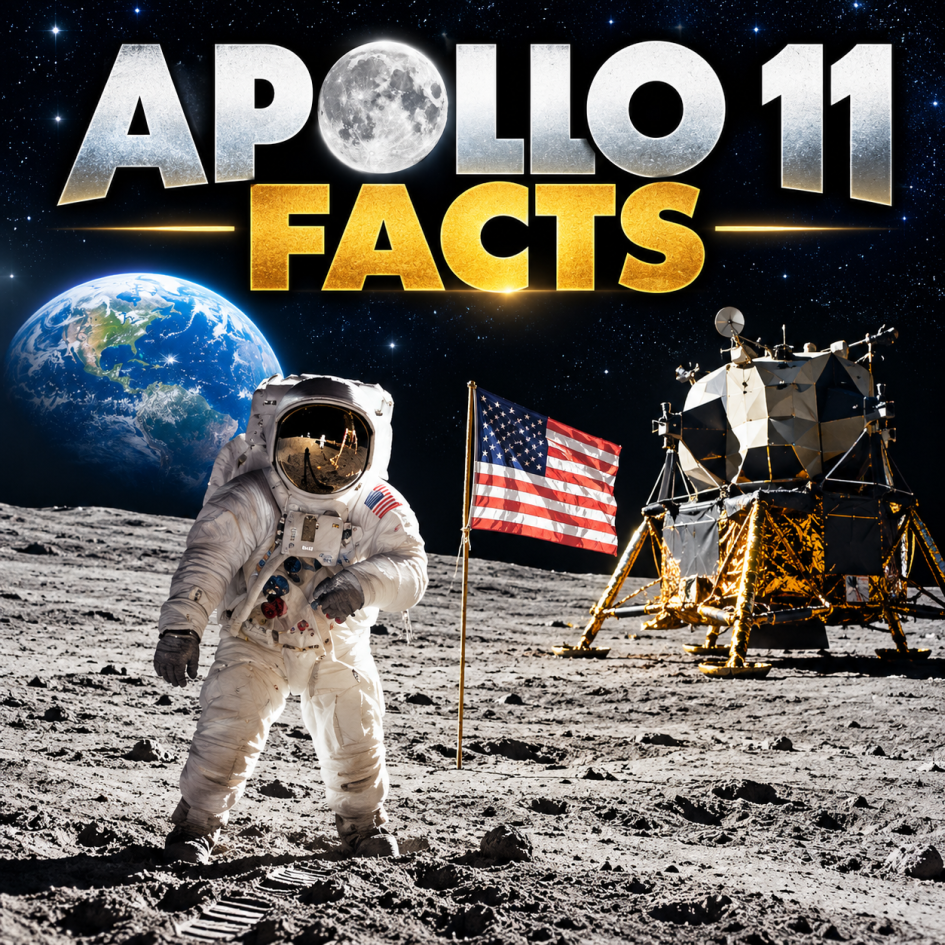
Apollo 11 was one of the most important missions in human history. In July 1969, NASA sent three astronauts to the Moon, achieving a goal that had inspired people around the world. Here are 20 fascinating facts about the historic mission.
1. It was the first Moon landing
Apollo 11 was the first mission to land humans on the Moon. It fulfilled President John F. Kennedy’s goal of landing a man on the Moon and returning him safely to Earth before the end of the 1960s.
2. Three astronauts took part
The crew consisted of Neil Armstrong, Buzz Aldrin and Michael Collins. Each astronaut had a different role in making the mission successful.
3. It launched on 16 July 1969
The spacecraft launched from Kennedy Space Center in Florida. Millions of people watched the enormous rocket rise into the sky.
4. The rocket was incredibly powerful
Apollo 11 was launched using the Saturn V rocket, which stood approximately 110 metres tall. It remains one of the most powerful rockets ever successfully flown.
5. Neil Armstrong was the first person on the Moon
On 20 July 1969, Armstrong stepped onto the lunar surface. His historic achievement made him the first human to walk on another world.
6. Buzz Aldrin followed Armstrong
Aldrin joined Armstrong on the Moon about 19 minutes later. Together, they explored the surface, collected samples and conducted experiments.
7. Michael Collins stayed in orbit
Collins remained aboard the command module, Columbia, orbiting the Moon while Armstrong and Aldrin explored. His job was essential because he had to reunite with the lunar module for the return journey.
8. The lunar module was called Eagle
The lunar module, named Eagle, carried Armstrong and Aldrin down to the Moon. Its landing became famous through the message, “The Eagle has landed.”
9. The landing was almost aborted
During the final descent, computer alarms sounded, and Armstrong noticed that the spacecraft was heading towards a boulder-strewn area. He manually guided Eagle to a safer landing site with very little fuel remaining.
10. Armstrong’s first step became legendary
Armstrong’s famous words were, “That’s one small step for a man, one giant leap for mankind.” The statement captured the importance of humanity’s first steps on the Moon.
11. The astronauts spent hours outside
Armstrong and Aldrin spent approximately two and a half hours outside the lunar module, exploring the surface and gathering scientific information.
12. They collected Moon rocks
The astronauts collected around 21.5 kilograms of lunar material. Scientists later studied these samples to learn more about the Moon’s age, composition and history.
13. They planted an American flag
The astronauts planted a United States flag on the Moon. Because the Moon has no atmosphere, the flag could not flutter naturally in the wind.
14. They left objects behind
The astronauts left scientific instruments, equipment and a commemorative plaque on the lunar surface. The plaque declared that they came in peace on behalf of all humanity.
15. Millions watched on television
An estimated 600 million people worldwide watched the Moon landing on television, making it one of the largest shared viewing events in history.
16. The Moon has weaker gravity
The Moon’s gravity is about one-sixth of Earth’s. This allowed the astronauts to make long, bouncing steps while wearing their heavy spacesuits.
17. Their spacesuits were specially designed
The suits protected the astronauts from extreme temperatures, harmful radiation and the vacuum of space. They also supplied oxygen and helped regulate body temperature.
18. The journey took about eight days
Apollo 11 launched on 16 July and splashed down in the Pacific Ocean on 24 July 1969. The entire mission lasted approximately eight days.
19. The astronauts quarantined after returning
After landing on Earth, the crew spent 21 days in quarantine because scientists wanted to ensure they had not brought potentially dangerous lunar microorganisms back with them.
20. Apollo 11 changed history
The mission demonstrated that humans could travel to another celestial body and return safely. It advanced science, technology and space exploration, inspiring generations of scientists and astronauts.
Conclusion:
Apollo 11 was much more than a journey to the Moon. It represented human curiosity, courage and cooperation, proving that an extraordinary dream could become reality through scientific discovery and determination. Its legacy continues to influence space exploration today.
Leave a Reply