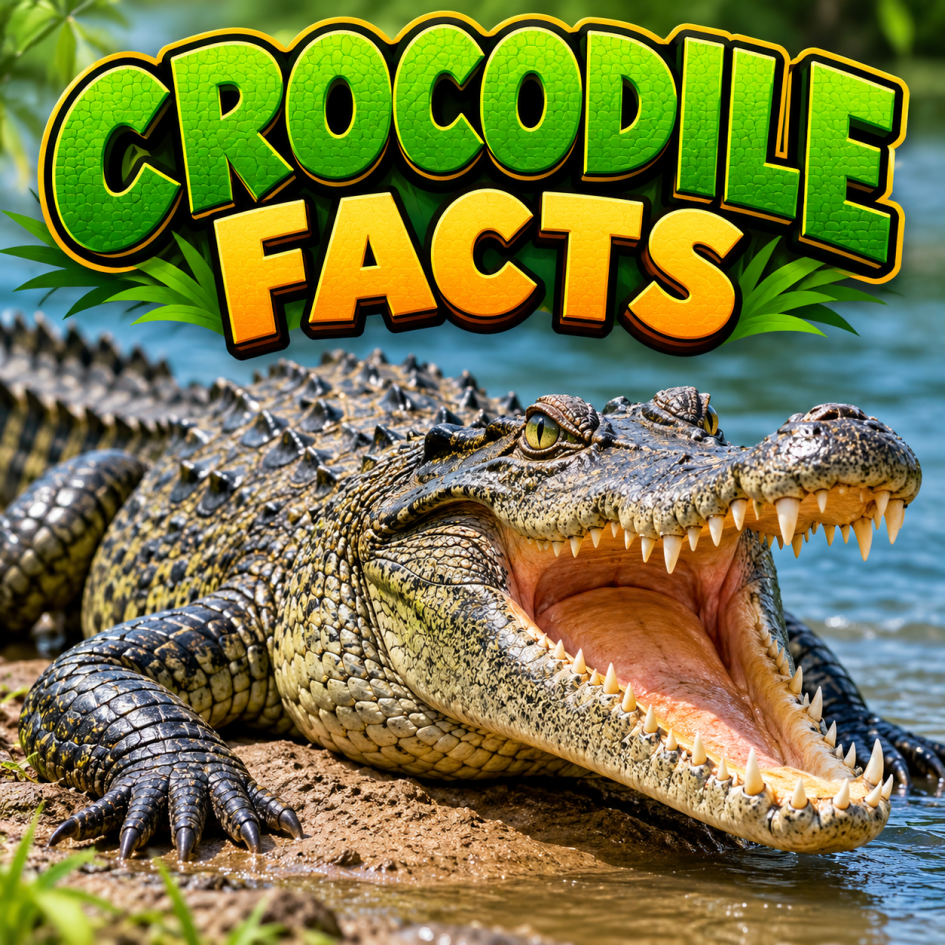
Crocodiles are fascinating reptiles that have lived on Earth for millions of years. They are powerful hunters with incredible senses, strong jaws and amazing survival skills. Here are 20 interesting facts about these remarkable animals.
1. Crocodiles are ancient animals.
Crocodile ancestors appeared over 200 million years ago. They lived alongside dinosaurs and survived several major changes in Earth’s environment.
2. They are reptiles.
Crocodiles belong to the reptile group, just like snakes, lizards and turtles. They have tough, scaly skin and breathe air using lungs.
3. They can grow enormous.
The saltwater crocodile is the largest living crocodile species. Some individuals can grow beyond six metres long and weigh over 1,000 kilograms.
4. They have incredibly powerful jaws.
Crocodiles have one of the strongest measured bite forces of any living animal. Their jaws are designed to grab and hold prey firmly.
5. They replace their teeth.
Crocodiles can grow new teeth throughout their lives. A single crocodile may replace thousands of teeth over its lifetime.
6. They are excellent swimmers.
Their muscular tails push them through the water, while their webbed feet help with steering.
7. They can stay underwater for a long time.
When resting, crocodiles can sometimes remain submerged for an hour or longer, depending on conditions and activity.
8. They have special eyes.
Crocodiles have a protective third eyelid, called a nictitating membrane, which helps protect their eyes underwater.
9. They can see in dim light.
Their eyes are adapted for hunting at night and in low-light conditions, making them effective nocturnal predators.
10. They are meat-eaters.
Crocodiles eat fish, birds, reptiles and mammals. Larger individuals can capture sizeable prey when the opportunity arises.
11. They use ambush hunting.
Instead of chasing every animal they see, crocodiles often wait quietly near the water’s edge before launching a sudden attack.
12. They cannot chew like humans.
Crocodiles usually swallow smaller prey whole. Larger prey may be torn into manageable pieces using powerful movements of the head and body.
13. They swallow stones.
Some crocodiles have stones in their stomachs, called gastroliths. These may help with digestion or balance, although their precise functions are not fully understood.
14. Mother crocodiles protect their eggs.
Females build nests from vegetation or soil and often guard them against predators until the eggs hatch.
15. Baby crocodiles communicate before hatching.
Hatchlings can make sounds from inside their eggs, helping alert their mother that they are ready to emerge.
16. Some mothers carry their babies.
A female may gently carry newly hatched crocodiles to the water inside her mouth, protecting them during their journey.
17. Temperature affects their sex.
In many crocodile species, the temperature at which eggs develop helps determine whether hatchlings are male or female.
18. They are cold-blooded.
Crocodiles rely on their surroundings to regulate body temperature. They bask in the sun to warm up and move into shade or water to cool down.
19. They live in several regions.
Crocodiles inhabit tropical parts of Africa, Asia, Australia and the Americas. Different species live in freshwater, brackish water and, in some cases, coastal saltwater habitats.
20. They are important to ecosystems.
As top predators, crocodiles help regulate populations of other animals. Their feeding activities can also move nutrients around aquatic environments.
Conclusion:
Crocodiles are much more than frightening predators. Their ancient history, remarkable adaptations and protective parenting make them some of the most extraordinary reptiles on Earth. Although they are fascinating to observe, they are dangerous wild animals and should always be watched from a safe distance.
Leave a Reply