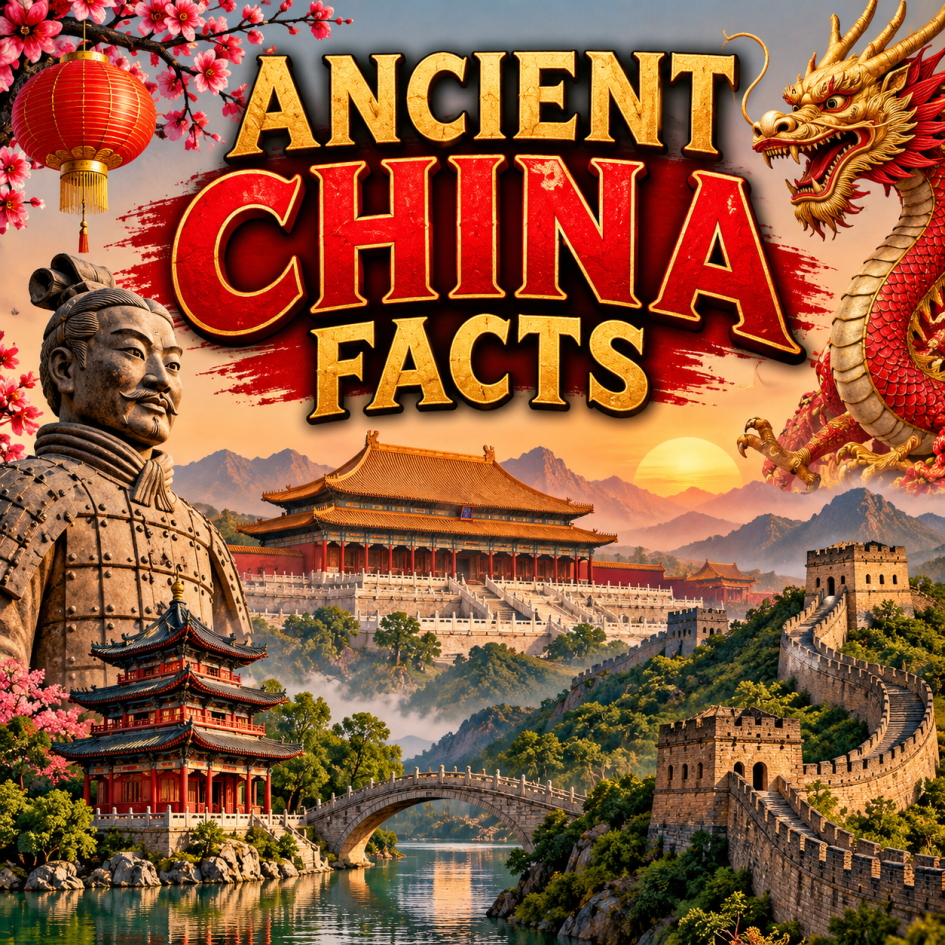
Ancient China was one of the world’s earliest and most influential civilisations. It developed remarkable inventions, built enormous structures, and created traditions that continue to influence the world today. Here are 20 fascinating facts about ancient China.
1. Ancient China Began Thousands of Years Ago
Chinese civilisation began thousands of years ago, with early farming communities developing along the Yellow River and Yangtze River. These communities grew into towns, kingdoms, and eventually powerful dynasties.
2. The First Chinese Dynasty
The Xia dynasty is traditionally considered China’s first dynasty. It is said to have ruled around 2070–1600 BCE, although historians still debate how much of its history is supported by archaeological evidence.
3. The Great Wall of China
The Great Wall was built and expanded over many centuries to help defend Chinese territories from northern invasions. Many sections visitors see today were built during the Ming dynasty, between 1368 and 1644 CE.
4. The Terracotta Army
In 1974, farmers discovered thousands of terracotta soldiers near the tomb of Qin Shi Huang, China’s first emperor. The life-sized figures were created to guard him in the afterlife.
5. Paper Was Invented in China
Paper-making developed in ancient China. Around 105 CE, an official named Cai Lun is traditionally credited with improving the process using materials such as bark, hemp, and old cloth.
6. The Invention of Gunpowder
Chinese alchemists discovered gunpowder while experimenting with substances in search of life-extending medicines. It was later used in fireworks, weapons, and military technology.
7. The Compass Helped Navigation
Early Chinese compasses used lodestone, a naturally magnetic mineral. Over time, compass technology became important for navigation and helped sailors travel more reliably.
8. Silk Was Extremely Valuable
China developed silk production thousands of years ago. Silk became a valuable trading product, eventually travelling along routes known as the Silk Road.
9. The Silk Road Connected Civilisations
The Silk Road was a network of trade routes linking China with Central Asia, the Middle East, and Europe. Traders exchanged silk, spices, precious stones, ideas, and religious beliefs.
10. Chinese Dragons Were Symbols of Power
In Chinese culture, dragons were often associated with good fortune, strength, rain, and imperial authority. Unlike many European dragons, they were not usually portrayed as evil creatures.
11. The Emperor Ruled the Empire
The emperor held supreme authority and was believed to rule under the Mandate of Heaven. This idea suggested that rulers could lose their right to govern if they became unjust or failed their people.
12. Confucius Influenced Chinese Society
Confucius was a philosopher who lived from 551 to 479 BCE. His teachings emphasised respect, education, honesty, family relationships, and responsible leadership.
13. Ancient China Had Advanced Agriculture
Farmers cultivated rice, millet, wheat, and other crops. Irrigation systems and farming techniques helped support growing populations and powerful cities.
14. Tea Drinking Began in China
Tea has a long history in China. According to legend, Emperor Shennong discovered tea accidentally, but the story is not historically verified. Tea eventually became an important part of Chinese culture.
15. Ancient Chinese Writing
Chinese writing developed from early symbols carved onto bones and turtle shells. These inscriptions, known as oracle-bone script, were used during the Shang dynasty for divination and recording questions to the ancestors.
16. Bronze Was Used for Important Objects
Ancient Chinese craftspeople created impressive bronze vessels, weapons, bells, and ritual objects. Bronze-working became particularly advanced during the Shang and Zhou dynasties.
17. The Chinese Zodiac Has Twelve Animals
The traditional Chinese zodiac uses twelve animals, including the rat, tiger, rabbit, dragon, snake, and horse. Each animal represents a year in a repeating twelve-year cycle.
18. Ancient China Had Powerful Armies
Chinese armies used bows, crossbows, swords, spears, and chariots. During different periods, military innovations helped rulers expand territories and defend their kingdoms.
19. Porcelain Became a Famous Chinese Invention
Chinese pottery developed over many centuries, eventually producing fine porcelain. This beautiful, durable ceramic became highly prized by traders and collectors around the world.
20. Ancient Chinese Inventions Changed the World
Paper, printing, gunpowder, and the compass are often called the Four Great Inventions of ancient China. Their development and spread influenced education, communication, navigation, and warfare across the world.
Conclusion
Ancient China made extraordinary contributions to human civilisation. Its inventions, philosophies, architecture, and trading networks helped shape world history. From the Great Wall to the Silk Road, its achievements continue to fascinate people today.
Leave a Reply