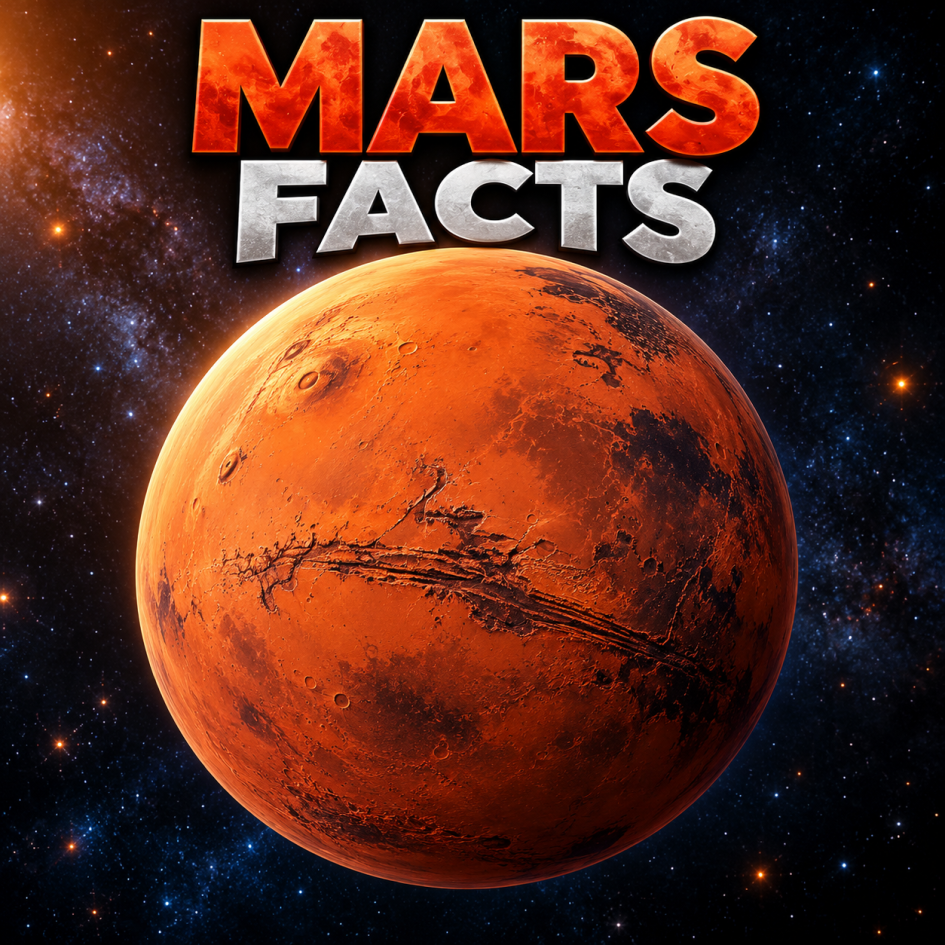
Mars is the fourth planet from the Sun and one of the most fascinating planets in our Solar System. Known as the Red Planet, Mars has attracted scientists for centuries because of its unusual landscape, icy poles, and the possibility that life may once have existed there. Here are 20 interesting facts about Mars.
1. Mars is known as the Red Planet.
Mars gets its reddish colour from iron oxide, commonly known as rust, which is found in the rocks and dust covering its surface.
2. Mars is the fourth planet from the Sun.
It comes after Mercury, Venus, and Earth. Mars is approximately 228 million kilometres from the Sun on average.
3. Mars is smaller than Earth.
Mars has a diameter of about 6,779 kilometres, making it roughly half the diameter of Earth.
4. A day on Mars is similar to a day on Earth.
One Martian day, called a sol, lasts approximately 24 hours and 37 minutes.
5. A year on Mars is much longer than a year on Earth.
Mars takes about 687 Earth days to complete one orbit around the Sun. This means its year is almost twice as long as ours.
6. Mars has two moons.
Its moons are called Phobos and Deimos. Both are small and irregularly shaped, unlike Earth’s nearly spherical Moon.
7. Mars has the largest volcano in the Solar System.
Olympus Mons is a giant shield volcano measuring approximately 22 kilometres high. That makes it nearly two and a half times the height of Mount Everest.
8. Mars has a gigantic canyon system.
Valles Marineris stretches for around 4,000 kilometres across the Martian surface. In places, it is up to about 7 kilometres deep.
9. Mars is extremely cold.
The average surface temperature is around −65°C, although temperatures can vary greatly depending on the location and season.
10. Mars has a very thin atmosphere.
Its atmosphere is mostly carbon dioxide. Because it is so thin, it provides little warmth and offers limited protection from harmful radiation.
11. Water exists on Mars.
Scientists have found evidence of ancient rivers, lakes, and other water-related features. Today, much of the planet’s known water is frozen in polar ice caps and beneath the surface.
12. Mars may once have supported microbial life.
Ancient environments on Mars may have been suitable for simple life. However, no confirmed evidence of past or present life has been discovered.
13. Mars experiences dust storms.
Dust storms can spread across enormous areas and sometimes engulf almost the entire planet, lasting for weeks or months.
14. Mars has seasons.
Like Earth, Mars has spring, summer, autumn, and winter because its axis is tilted. However, its seasons last much longer.
15. Gravity is weaker on Mars.
Gravity on Mars is about 38% of Earth’s. A person weighing 60 kilograms on Earth would experience a weight equivalent to roughly 23 kilograms on Mars.
16. Robots have explored Mars.
NASA has sent several successful robotic missions, including the Curiosity and Perseverance rovers, to investigate its rocks, climate, and habitability.
17. Mars has blue sunsets.
Although Mars appears red during the day, sunsets can look bluish near the Sun because fine dust scatters light differently from Earth’s atmosphere.
18. Mars has polar ice caps.
Both poles contain ice made from water and frozen carbon dioxide. These ice caps change in size with the Martian seasons.
19. Humans have never walked on Mars.
All exploration so far has been conducted by spacecraft, landers, and robotic rovers. Sending humans to Mars remains a major goal for future space exploration.
20. Mars could help us understand Earth’s future and past.
Studying Mars helps scientists understand how planets evolve, how climates change, and whether life might exist beyond Earth.
Conclusion
Mars is a world of enormous volcanoes, deep canyons, freezing temperatures, and intriguing evidence of ancient water. Although it is currently a harsh environment, it remains one of the most promising places to investigate the possibility of life beyond Earth. Future missions may reveal even more secrets about the Red Planet and whether humans could one day visit it.
Leave a Reply