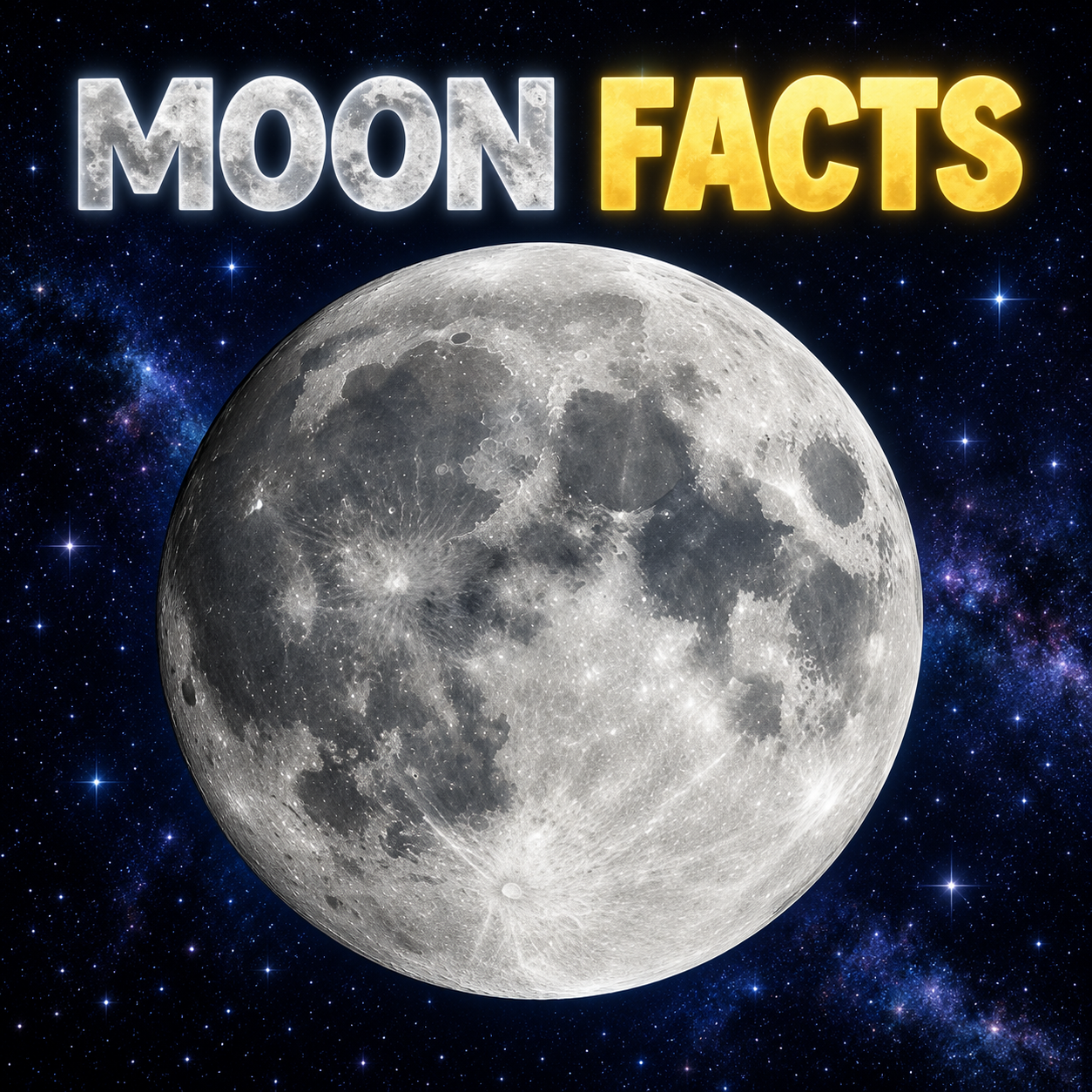
The Moon is Earth’s closest neighbour in space and one of the most fascinating objects in our solar system. It lights up our night skies, influences ocean tides, and has inspired scientists and explorers for centuries. Here are 20 amazing facts about the Moon!
1. The Moon is Earth’s natural satellite.
The Moon travels around Earth in space. It is the fifth-largest natural satellite in the solar system and the largest compared with the size of its planet.
2. The Moon is about 4.5 billion years old.
Scientists believe the Moon formed around 4.5 billion years ago, shortly after Earth formed. It probably developed from debris created when a Mars-sized object collided with the young Earth.
3. The Moon is much smaller than Earth.
The Moon has a diameter of approximately 3,475 kilometres. Earth’s diameter is about 12,742 kilometres, making our planet nearly four times wider.
4. The Moon has weaker gravity.
Gravity on the Moon is about one-sixth as strong as Earth’s. A person who weighs 60 kilograms on Earth would experience a weight equivalent to about 10 kilograms on the Moon.
5. The Moon does not produce its own light.
The Moon looks bright because it reflects sunlight. Its surface absorbs some sunlight and reflects the rest back into space, making it visible from Earth.
6. The Moon has different phases.
The Moon appears to change shape throughout the month. These phases include the new moon, crescent moon, half moon, and full moon. They occur because we see different portions of its sunlit side.
7. The Moon influences ocean tides.
The Moon’s gravitational pull helps create ocean tides on Earth. The Sun also influences tides, but the Moon is especially important because it is much closer to our planet.
8. A day on the Moon lasts a long time.
One complete rotation of the Moon takes about 27.3 Earth days. However, from one sunrise to the next at a particular location, a lunar day lasts about 29.5 Earth days.
9. The Moon has no breathable atmosphere.
Unlike Earth, the Moon has virtually no atmosphere. This means humans cannot breathe there without special equipment, and the surface is exposed to extreme temperatures and radiation.
10. The Moon has many craters.
The Moon’s surface contains thousands of craters created by asteroids and other space objects crashing into it. Because it has little weathering, many of these craters remain visible for billions of years.
11. Humans have walked on the Moon.
On 20 July 1969, astronaut Neil Armstrong became the first person to walk on the Moon during NASA’s Apollo 11 mission. Buzz Aldrin joined him on the surface shortly afterwards.
12. The Moon has mountains.
The Moon contains mountains, valleys, plains, and deep craters. Some lunar mountains rise several kilometres above the surrounding landscape.
13. The Moon has moonquakes.
Scientists have detected moonquakes using instruments placed on the lunar surface. Some are caused by tidal forces, while others are associated with impacts or changes within the Moon.
14. The Moon always shows nearly the same face to Earth.
The Moon rotates as it orbits Earth. These movements take approximately the same amount of time, a phenomenon called synchronous rotation. This is why we usually see the same side.
15. The Moon has water ice.
Scientists have found evidence of water ice in permanently shadowed craters near the Moon’s poles. This water could be useful for future astronauts and lunar exploration.
16. Temperatures on the Moon are extreme.
Temperatures can reach around 127°C in direct sunlight and fall to approximately −173°C at night. Some permanently shadowed polar regions are even colder.
17. The Moon is slowly moving away from Earth.
The Moon moves away from Earth by approximately 3.8 centimetres each year. Scientists measure this distance using lasers bounced off reflectors left by astronauts and robotic missions.
18. Solar eclipses happen because of the Moon.
A solar eclipse occurs when the Moon passes between Earth and the Sun, blocking some or all of the Sun from view. A total solar eclipse can make daytime skies temporarily dark.
19. The Moon has dark and light areas.
The dark patches visible on the Moon are called maria. They are vast plains formed by ancient volcanic activity. The lighter areas are generally older, heavily cratered highlands.
20. The Moon helps scientists explore space.
Studying the Moon helps scientists understand how Earth and the solar system formed. It is also an important destination for future missions that may prepare humans for exploring Mars and other worlds.
Conclusion
The Moon is much more than a beautiful object in the night sky. It has a fascinating history, affects life on Earth, and holds important clues about the universe. As technology advances, scientists continue discovering new things about our closest celestial neighbour. Perhaps future generations will even live and work on the Moon!
Leave a Reply