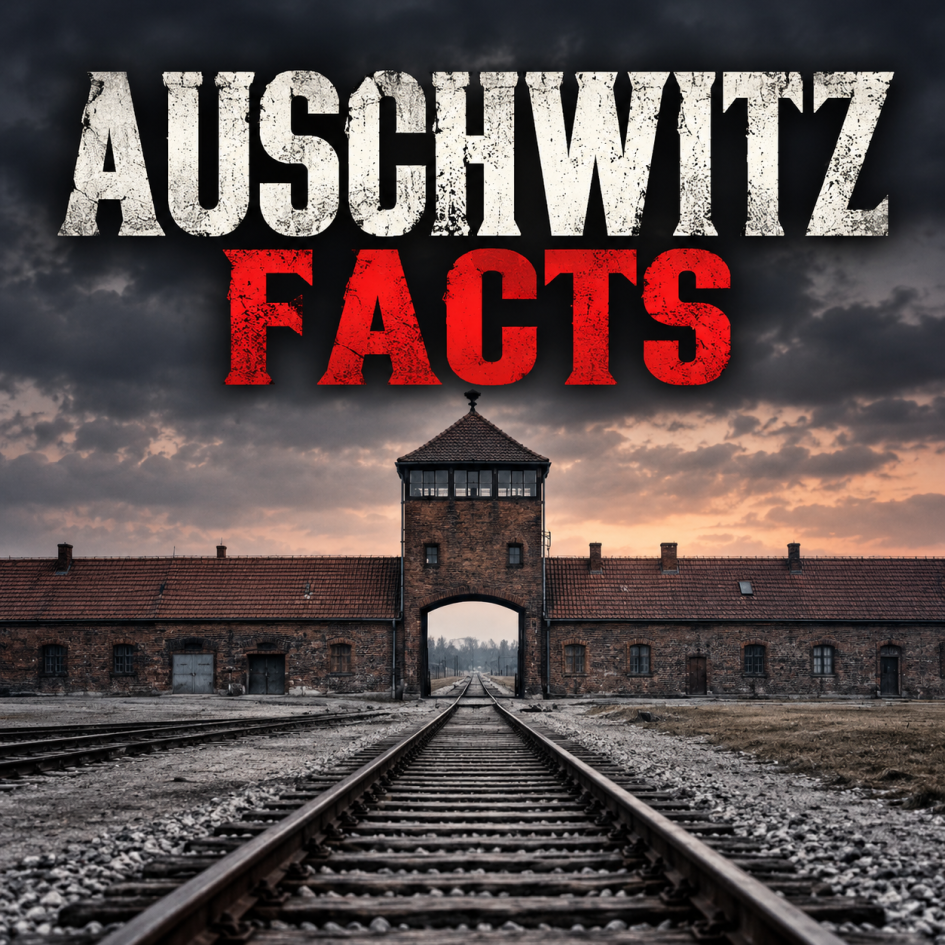
Auschwitz was the largest Nazi German concentration and extermination camp complex during the Holocaust. Located in German-occupied Poland during the Second World War, it became one of the most infamous symbols of the persecution and mass murder of millions of innocent people. Here are 20 interesting Auschwitz facts.
1. Auschwitz opened in 1940. The Nazis established Auschwitz I in May 1940, initially imprisoning Polish political prisoners and other people they considered enemies.
2. It was located in occupied Poland. The camp stood near the town of Oświęcim, which Nazi Germany had annexed and renamed Auschwitz after invading Poland in 1939.
3. Auschwitz was a complex of camps. It included Auschwitz I, Auschwitz II-Birkenau and Auschwitz III-Monowitz, alongside numerous subcamps.
4. Birkenau became a major extermination centre. Auschwitz II-Birkenau was developed into the principal site of mass murder within the complex.
5. Approximately 1.1 million people were murdered there. Historians estimate that around 1.1 million people died at Auschwitz, the overwhelming majority of them Jews.
6. Jews were the largest victim group. Approximately one million Jewish people were murdered at Auschwitz as part of the Nazis’ systematic genocide of European Jewry.
7. Many victims were murdered immediately after arrival. During selections, SS personnel decided who would be forced into labour and who would be sent directly to their deaths. Many children, older people and those judged unable to work were killed upon arrival.
8. Gas chambers were used for mass murder. The Nazis used Zyklon B, a pesticide containing hydrogen cyanide, to murder victims in gas chambers at Auschwitz.
9. Prisoners suffered brutal forced labour. Inmates were compelled to work under extreme conditions, often with inadequate food, clothing and medical care. Exhaustion, disease and violence killed many.
10. Children were among the victims. Jewish children and children from other persecuted groups were imprisoned, subjected to medical experiments or murdered. Many young children were killed shortly after arriving.
11. Prisoners were stripped of their identities. Many registered prisoners had their personal belongings confiscated and were assigned numbers. Some prisoners had their numbers tattooed on their bodies.
12. Families were separated. Upon arrival, family members were often separated during selection. Many never saw their loved ones again.
13. Medical experiments took place. Nazi doctors, including Josef Mengele, conducted cruel and often deadly experiments on prisoners, including twins and children, without consent.
14. Prisoners were deliberately starved. Food rations were grossly inadequate for the exhausting labour demanded of prisoners. Malnutrition weakened people and increased their risk of disease and death.
15. Some prisoners resisted. In October 1944, members of the Sonderkommando, prisoners forced to work around the crematoria, staged an uprising and damaged one of the crematoria at Birkenau.
16. Prisoners attempted escapes. Although escape was extremely dangerous, some prisoners tried to flee. Successful escapees sometimes helped inform the outside world about the mass murder taking place.
17. The Nazis tried to destroy evidence. As defeat approached, the SS demolished gas chambers and crematoria and destroyed documents to conceal their crimes.
18. Death marches took place in January 1945. As Soviet troops advanced, the Nazis forced tens of thousands of prisoners to leave Auschwitz on brutal marches. Many died from exhaustion, exposure, starvation or shootings.
19. Soviet troops liberated Auschwitz on 27 January 1945. They found several thousand surviving prisoners, many seriously ill and severely malnourished. The date is now commemorated internationally as Holocaust Remembrance Day.
20. Auschwitz is now a memorial and museum. The Auschwitz-Birkenau State Museum preserves the former camp, historical documents and surviving objects to educate visitors and honour the victims. Its purpose includes helping future generations understand the consequences of antisemitism, racism and hatred.
Why these facts matter
Auschwitz was not simply a place of imprisonment. It was a central site of the Holocaust, where Nazi Germany and its collaborators systematically persecuted and murdered people on an enormous scale. Remembering the victims, studying the historical evidence and listening to survivors’ testimonies are essential to confronting Holocaust denial and preventing future atrocities.
Leave a Reply