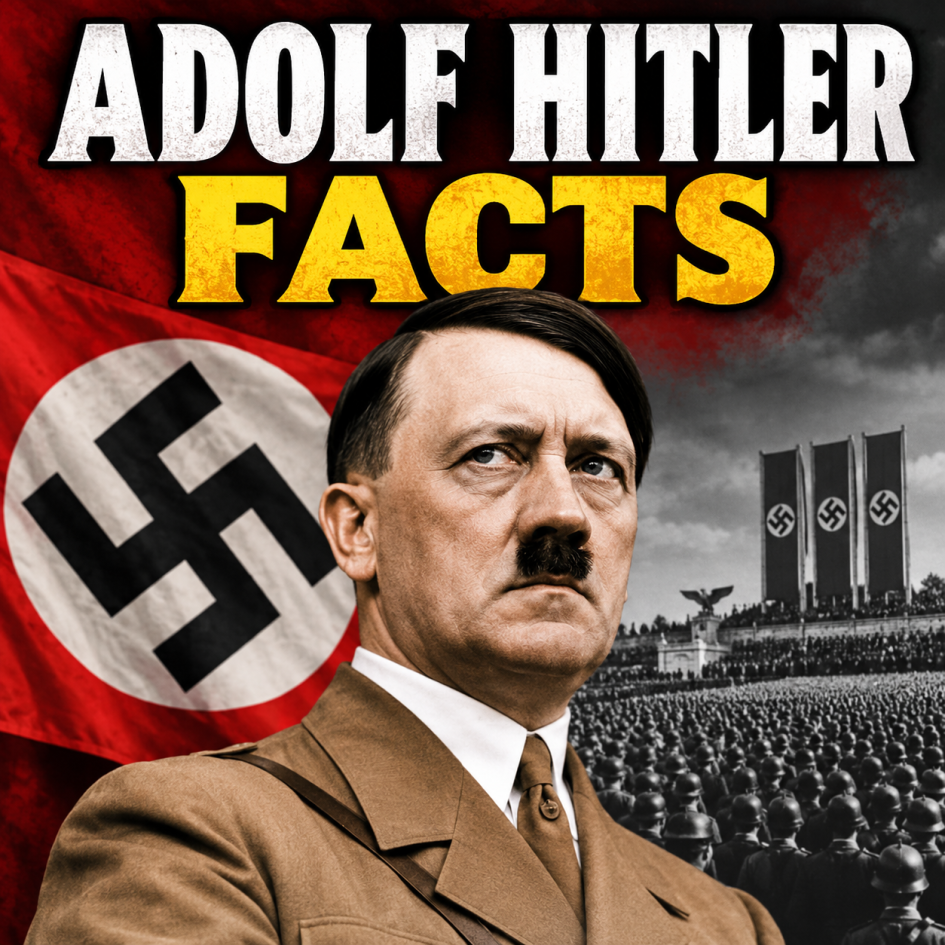
Adolf Hitler was the dictator of Nazi Germany from 1933 to 1945. He played a central role in starting the Second World War in Europe and was responsible for the Holocaust, the systematic murder of six million Jews, alongside the persecution and murder of millions of other victims. Here are 20 important facts about his life, political rise, and historical impact.
1. He was born in Austria.
Adolf Hitler was born on 20 April 1889 in Braunau am Inn, a town in Austria-Hungary, near the German border.
2. His family background was ordinary.
His father, Alois Hitler, worked as a customs official, while his mother, Klara Hitler, was a homemaker. Adolf was one of six children born to his parents, although several died during childhood.
3. He wanted to become an artist.
As a young man, Hitler dreamed of becoming a professional artist. However, the Academy of Fine Arts Vienna rejected his applications in 1907 and 1908.
4. He lived in Vienna.
Between 1908 and 1913, Hitler spent much of his time in Vienna, experiencing poverty and earning some money by selling paintings and postcards.
5. He served in the First World War.
Hitler served in the German Army during the First World War (1914–1918), mainly as a dispatch runner. He received the Iron Cross for his military service.
6. Germany’s defeat influenced his politics.
Germany’s defeat in 1918 and the political instability that followed contributed to Hitler’s extremist nationalism. He promoted the false claim that Germany had been betrayed from within.
7. He joined a small political party.
In 1919, Hitler joined the German Workers’ Party, which later became the National Socialist German Workers’ Party, commonly known as the Nazi Party.
8. He became a powerful public speaker.
Hitler used emotional speeches, propaganda, and public rallies to attract supporters. He exploited economic hardship, political divisions, antisemitism, and resentment after the war.
9. He attempted a failed coup.
In November 1923, Hitler and his supporters attempted to overthrow the German government in Munich. The Beer Hall Putsch failed, and Hitler was arrested.
10. He wrote Mein Kampf.
While imprisoned after the failed coup, Hitler began writing Mein Kampf (My Struggle). Published in two volumes in 1925 and 1926, it outlined his racist ideology, antisemitism, and expansionist ambitions.
11. He became German chancellor in 1933.
On 30 January 1933, President Paul von Hindenburg appointed Hitler chancellor of Germany.
12. He dismantled democracy.
After the Reichstag fire in February 1933, the Nazi government restricted civil liberties. The Enabling Act of March 1933 allowed Hitler’s government to make laws without parliamentary approval, helping establish dictatorship.
13. He persecuted Jewish people.
The Nazi regime introduced discriminatory laws, including the Nuremberg Laws of 1935, which stripped Jews of important rights and citizenship protections.
14. He began the Second World War in Europe.
On 1 September 1939, Nazi Germany invaded Poland. Britain and France declared war on Germany two days later.
15. He ordered the invasion of the Soviet Union.
In June 1941, Germany launched Operation Barbarossa, a massive invasion of the Soviet Union that resulted in devastating military and civilian casualties.
16. He was responsible for the Holocaust.
Hitler’s regime orchestrated the Holocaust, murdering approximately six million Jews. Millions of other people, including Roma, disabled people, Soviet prisoners of war, Polish civilians, and others targeted by the Nazis, were also persecuted and killed.
17. He survived an assassination attempt.
On 20 July 1944, German army officer Claus von Stauffenberg attempted to kill Hitler with a bomb. Hitler survived with injuries.
18. His regime collapsed in 1945.
By early 1945, Allied forces were advancing into Germany from the east and west. Berlin became the centre of the regime’s final collapse.
19. He died by suicide.
On 30 April 1945, Hitler died by suicide in his bunker in Berlin as Soviet forces approached the city. His wife, Eva Braun, also died by suicide.
20. His legacy remains a warning.
Hitler’s dictatorship caused immense destruction, genocide, and suffering. His rise demonstrates how extremist ideology, propaganda, discrimination, and the destruction of democratic institutions can lead to catastrophic consequences.
Conclusion:
Adolf Hitler remains one of history’s most notorious dictators. Studying his life helps explain the origins of the Second World War, the Holocaust, and the importance of protecting human rights and democratic institutions.
Leave a Reply