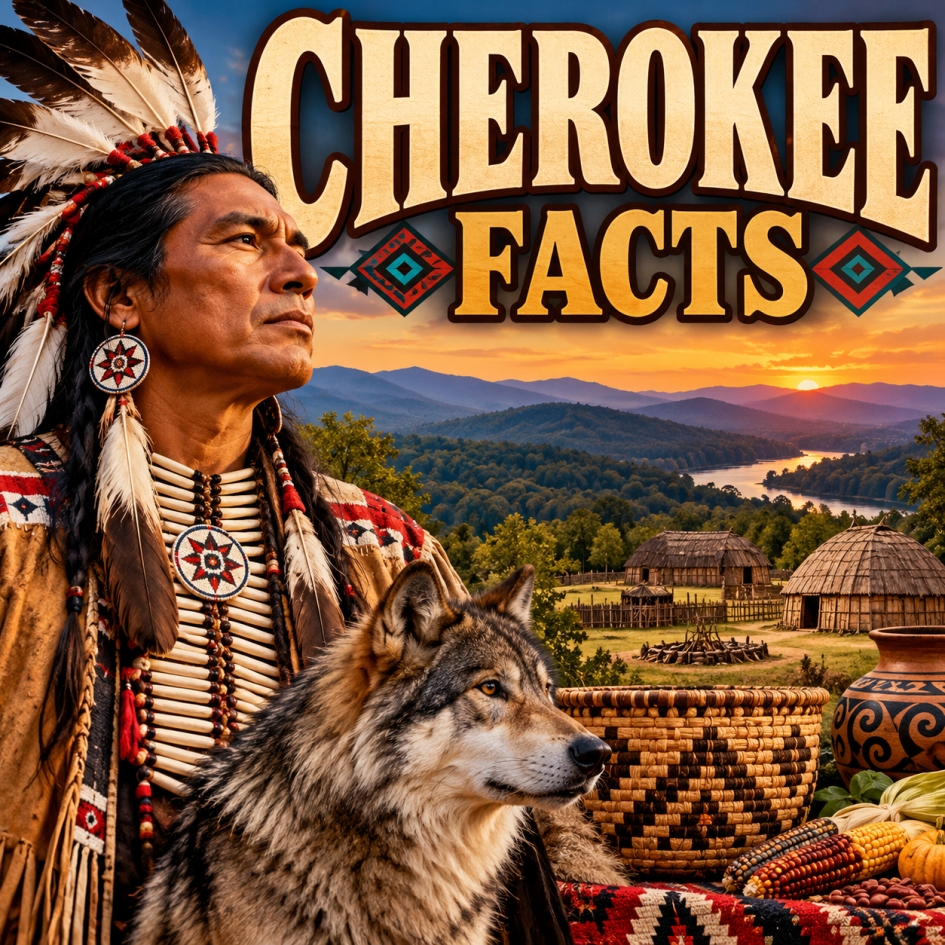
The Cherokee are one of the Indigenous peoples of North America, with a rich history, culture, language and traditions. Here are 20 interesting facts about the Cherokee people.
1. The Cherokee are Indigenous Americans.
The Cherokee are Indigenous people whose ancestral homelands are in the southeastern United States, including parts of present-day North Carolina, Georgia, Tennessee and Alabama.
2. They have their own language.
The Cherokee language, also called Tsalagi, belongs to the Iroquoian language family. It is different from English and has its own unique sounds and grammar.
3. They developed their own writing system.
In the early 1800s, a Cherokee man named Sequoyah created a writing system for the Cherokee language. It allowed people to read and write in their own language.
4. Sequoyah was an important figure.
Sequoyah developed a syllabary containing 85 symbols. His achievement helped increase literacy among Cherokee people.
5. They lived in permanent villages.
Historically, many Cherokee communities lived in villages containing homes, meeting places and agricultural fields. Houses were traditionally made using materials such as wood, bark and clay.
6. Farming was important.
The Cherokee grew crops such as corn, beans and squash. These foods were important parts of their traditional diet.
7. They hunted and fished.
Alongside farming, Cherokee people hunted animals, fished in rivers and gathered nuts, berries and other wild plants.
8. Their culture values community.
Family relationships, cooperation and helping others have played important roles in Cherokee society. Community traditions continue to be important today.
9. They had traditional spiritual beliefs.
Cherokee spiritual traditions often emphasised the relationship between people, nature and the spiritual world. Beliefs and practices have varied between communities and over time.
10. Storytelling preserved their history.
Traditional stories passed knowledge, values and cultural teachings from one generation to another. Storytelling remains an important way of preserving Cherokee heritage.
11. They created beautiful crafts.
Cherokee artists have made baskets, pottery, beadwork and carved objects. Basket weaving, in particular, is a respected traditional art.
12. The Cherokee had established governments.
Cherokee communities developed political systems and leadership structures. In the nineteenth century, the Cherokee Nation adopted a written constitution and established institutions of government.
13. They published a newspaper.
In 1828, the Cherokee Nation began publishing the Cherokee Phoenix. It printed news in English and Cherokee, using Sequoyah’s writing system.
14. They experienced forced removal.
During the 1830s, the United States government forced many Cherokee people from their homelands. This tragic event became known as the Trail of Tears.
15. Many died during the Trail of Tears.
Thousands of Cherokee people died from disease, hunger, exposure and exhaustion during forced removal to Indian Territory, in present-day Oklahoma.
16. Not all Cherokee people were removed.
Some Cherokee people remained in North Carolina, including ancestors of members of the Eastern Band of Cherokee Indians, which is a federally recognised tribe today.
17. The Cherokee Nation is based in Oklahoma.
The Cherokee Nation is one of three federally recognised Cherokee tribes in the United States. The United Keetoowah Band of Cherokee Indians is also based in Oklahoma.
18. Cherokee culture survives today.
Cherokee people continue to practise cultural traditions, celebrate their heritage, create art and strengthen their communities.
19. Language revitalisation is important.
Cherokee communities support language-learning programmes, educational resources and immersion schools to help keep the Cherokee language alive for future generations.
20. The Cherokee are a living people.
The Cherokee are not just part of history. Today, Cherokee citizens live throughout the United States and elsewhere, contributing to modern society while maintaining their distinct identities, traditions and connections to their ancestors.
Conclusion
The Cherokee people have a remarkable history of creativity, resilience and cultural achievement. From Sequoyah’s writing system to their continued efforts to preserve their language, they have made important contributions to Indigenous history. Despite the hardships of forced removal, Cherokee communities have survived and continue to protect their heritage for future generations.
Leave a Reply